Travel Wallets and Passport Holders: RFID Blocking, Organisation, and What's Overkill
We’ve all done the frantic pocket-pat at immigration, even when we know exactly where the passport is.
That moment of panic — that split second where you forget which pocket, which bag, which dimension you’ve stored the most important document of your trip — is universal. And it’s why an entire industry exists to sell you wallets, pouches, holders, and organisers that promise to make travel feel more… organised.
But here’s the thing: some of this stuff is genuinely useful, and some of it is just expensive peace of mind. Let’s figure out which is which.
The Paranoia Spectrum
Travel security exists on a spectrum. At one end: people who keep their passport loose in a backpack pocket and have never had a problem. At the other: people with a money belt, a neck pouch, AND a hidden leg wallet, looking like they’re prepping for a heist rather than a holiday.
Most of us should be somewhere in the middle.
I learned this the hard way when I was sleep-deprived after being up all night before an early flight. Spent ten minutes tearing through my bags looking for my passport, getting increasingly panicked, only to realise I’d already put it in my waist belt. Missed the flight. The security system worked, I suppose — I just couldn’t remember I was wearing it.
The real question isn’t “how can I hide my passport better?” It’s “how can I always know exactly where it is?”
Does RFID Blocking Actually Matter?
Here’s where it gets controversial.
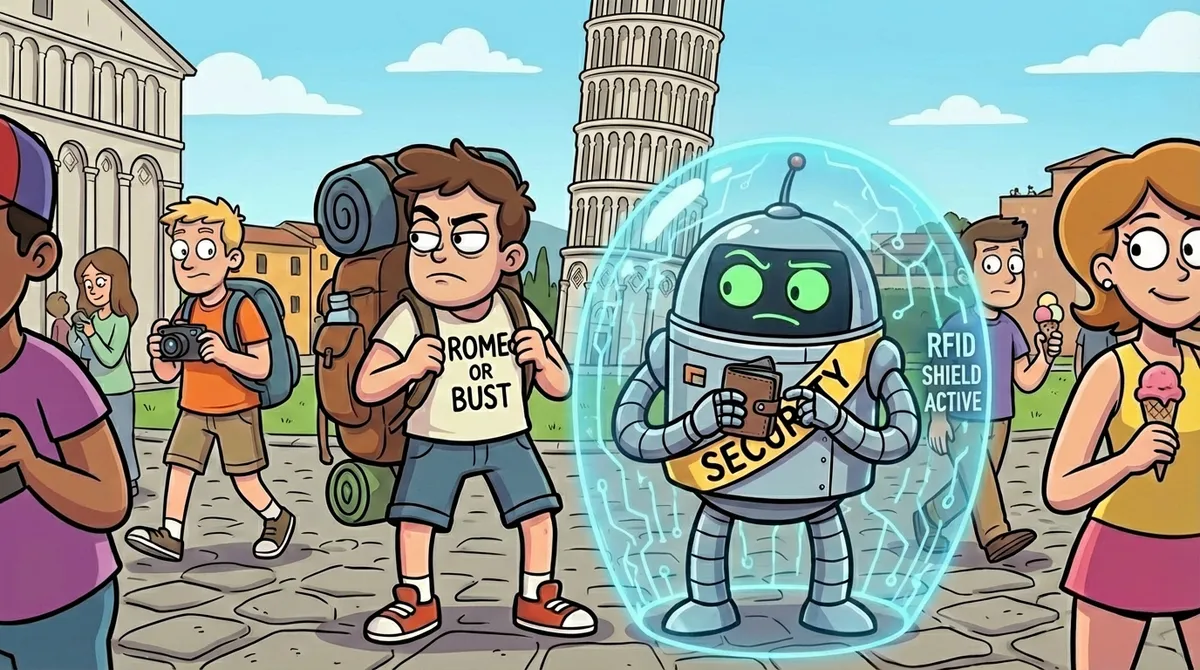
RFID blocking is a huge selling point for travel wallets. The pitch: criminals can scan your passport or credit cards remotely using hidden readers, stealing your data without ever touching you. Sounds terrifying. Sounds like you need protection.
The reality is… less dramatic.
RFID skimming in the wild is incredibly rare. Most security researchers agree the threat is largely theoretical. Your phone’s NFC reader can’t just vacuum up passport data from people walking past. The encryption on modern passports and chip cards makes casual theft impractical. And most fraud happens the old-fashioned way — online data breaches, phishing, someone watching you type your PIN.
That said, RFID blocking wallets don’t cost much more than regular ones. If it makes you feel better, get one. Just don’t pay a huge premium for it, and don’t think it’s protecting you from a major real-world threat.
Think of it like buying a padlock with a slightly fancier keyhole. Probably not what’s stopping the burglars, but it’s not hurting anything either.
The Passport Lanyard: A Public Service Announcement
The passport lanyard: for when you want everyone to know you’re a tourist AND that you don’t trust yourself.
Look, I get it. You want your passport accessible. You want both hands free. You don’t want to dig through bags at every checkpoint.
But there’s a cost. A passport swinging from your neck says “I am not from here and I have valuables on my person” in every language. It’s not the worst security decision you could make, but it’s also not the best idea.
If easy access is your priority, a travel wallet with a good system — same pocket, every time — beats broadcasting your tourist status to everyone in a three-metre radius.
What Actually Matters in a Travel Wallet
Forget the marketing. Here’s what genuinely makes a difference:
1. Consistency
The best travel wallet is one you’ll use the same way every time. Passport goes here. Cards go there. Boarding pass in this slot. If you have to think about it, you’ll forget it.
2. Size That Fits Your Style
Some people want everything in one place: passport, cards, phone, boarding passes, cash from three currencies partly sorted into denominations. Others want something slim they can slip in a jacket pocket.
Neither is wrong. Just be honest about which you’ll actually carry.
3. Durability
The cheap wallet that falls apart after one humid Southeast Asian summer isn’t a bargain. Leather that actually survives, or good-quality synthetic materials, will serve you better than something that looks nice in the shop.
4. Closure
Zippers beat magnets. Magnets beat nothing. You don’t want your passport sliding out when you set your bag down.
5. Protection for Your Travel Style
This is one people don’t think about until it’s too late.
I once had my passport in a waist belt while playing golf. Seemed secure. What I hadn’t considered: sweat and the occasional unexpected water hazard. By the end of the round, the passport had water damage. Some of the stamps had smeared.
Later, crossing into Myanmar, the water damage caused an issue with the scanner. The page wouldn’t read properly. I had a nervous few moments at the immigration counter — the kind where you’re mentally calculating how far away the nearest embassy is — before they checked it manually and waved me through.
The lesson: think about what you’ll actually be doing with your passport on you.
City hopping and business travel? A simple leather wallet is fine. You’re not exactly swimming through jungles.
Adventure travel, hiking, water activities? Consider something water-resistant. Dry bags exist for a reason. Some passport holders have waterproof linings.
Humid climates for extended periods? Even without direct water exposure, humidity can cause damage over time. A wallet with some moisture protection is worth considering.
Match your protection to your actual activities. A passport that can’t be scanned is a problem you don’t want at a border crossing.
The Korea-Japan Ferry Incident
Speaking of knowing where your passport is.
I was travelling from South Korea to Japan on the ferry with a friend. At the train station before boarding, the lady at the ticket counter checked our passports for our rail passes and handed them back. We didn’t check which one we each got.
Fast forward: my friend realises he left his bag on the overhead rail after getting off the train. In that bag: his (well, what he thought was his) passport.
I went back to delay our ferry tickets while he panicked. We asked the train staff for help. One guy was very keen to have a conversation about Australia through a colleague who spoke English — lovely, but the timing was interesting.
It happened to be my birthday. My friend tried to explain this to the staff, so I pulled out my passport to show the date and… saw my friend’s face staring back at me.
My passport was on the train.
Luckily, this was Japan. They found the bag, sent it back on another train, and nothing had been touched — including my actual passport. A good reminder that organisation matters, and also that low-crime countries are a blessing.
My Recommendations
Here’s what I’d actually suggest, depending on how you travel:
For Most Travellers
A simple bifold travel wallet with a passport slot, some card pockets, and a zip section for cash. Nothing fancy. Just consistent.
The wallet that feels good enough that you’ll use it every time — that’s the one.
Zero Grid Passport Holder & Travel Wallet with RFID Blocking
Budget-friendly, RFID blocking, and well-reviewed. Good starting point.
For Minimalists
If you just want cards and your passport in one slim holder, skip the organiser wallet entirely. A basic passport cover with a couple of card slots might be all you need.
Polare Slim RFID Blocking Leather Passport Holder Travel Bifold Wallet
Slim card holder for minimalists who don't need the full wallet experience.
For Families or Couples
When you’re managing multiple passports, you need more structure. Family passport organisers exist for a reason.
Topbag Family Travel Document Organizer
Holds multiple passports plus boarding passes. Good for wrangling travel documents for more than one person.
For the Genuinely Worried
If you’re in areas with known pickpocketing issues, or you just feel better with things hidden, a money belt or neck pouch can make sense. Just don’t go overboard.
HERO Neck Wallet, RFID Blocking Passport Holder
Sits under your shirt, out of sight. For when visible valuables feel risky.
Premium Option
If you travel frequently and want something that’ll last years, the Bellroy Travel Wallet is genuinely well-designed. Not cheap, but built properly.
Bellroy Passport Cover (slimline travel wallet/pouch with card slots and space for cash plus travel documents)
Premium quality for frequent travellers.
*Affiliate disclosure: Some links in this article are affiliate links. If you purchase through them, I may earn a small commission at no extra cost to you. *
The Sweet Spot
You don’t need a fortress of pouches. You don’t need RFID to save you from imaginary scanner criminals. You don’t need to be paranoid.
What you need is a system. Same place, every time. A wallet or holder you’ll actually use. And maybe one backup storage option for emergencies.
Travel security is mostly about habits, not hardware. The fanciest wallet in the world won’t help if you leave it on a train.