Quick-Dry Towels: Microfiber vs Alternatives
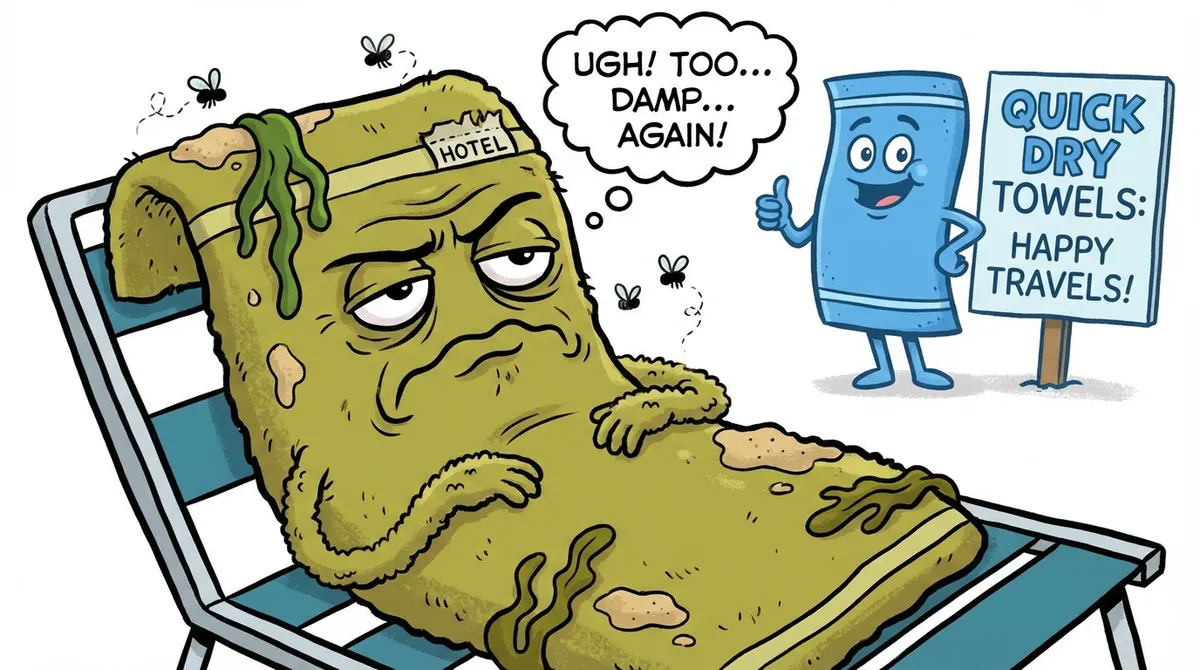
There’s a specific smell that happens when a regular towel has been damp in a backpack for too long. If you know, you know. If you don’t, I envy you.
I once used a hotel hand towel as a beach towel because my “regular” one had achieved sentience in my bag. It was a low point. Also a turning point.
If you’re travelling light — hostels, beaches, anything involving a locker with no airflow — your towel choice matters more than you’d think.
The Problem with Regular Towels
Cotton bath towels are lovely at home. Thick, absorbent, that satisfying fluff after a warm dryer cycle.
On the road? They’re a liability.
A regular cotton towel at hour six in a humid hostel: still damp, developing opinions. A microfiber towel at hour six: bone dry, ready for round two.
The issue is physics. Cotton holds water. That water needs somewhere to go. In a well-ventilated bathroom with proper airflow? Fine. Stuffed in a locker, rolled in a day pack, hanging in a shared bathroom with twelve other damp towels? That water has nowhere to go but into the smell.
And if you’re doing the beach-to-hostel transition — salt water, sand, sunscreen, then back to the shared shower — your towel needs to survive all of it and still be usable the next day.
Why Quick-Dry Towels Exist
Quick-dry towels use materials that don’t hold water the same way cotton does. They absorb moisture, then release it quickly when exposed to air. Some claim to dry ten times faster than regular towels. In practice, “noticeably faster” is more accurate, but that’s still the difference between a fresh towel and a mouldy disappointment.
They’re also smaller. A microfiber towel that does the job of a full bath towel can roll up to the size of a water bottle. For anyone weighing their bags or trying to fit everything in a carry-on, this matters.
Future-you, standing in a humid bathroom with a towel that won’t dry, will not appreciate past-you’s decision to “just bring my normal towel.”
Microfiber: The Default Choice
Microfiber is the go-to for most travellers, and for good reason. It’s light, compact, dries fast, and comes in every size from “barely covers anything” to “actual beach towel dimensions.”
The trade-off is feel. Microfiber has a slightly squeaky texture against skin — not unpleasant, but different. It’s like the difference between cotton sheets and performance athletic wear. Functional, not luxurious.
For budget-friendly options that do the job well, something like the Rainleaf or Wise Owl works for most people:
Wise Owl Outfitters Microfiber Towel
Rainleaf Microfiber Towel
The sweet spot for size is usually medium or large. The extra-small ones are tempting for minimalists but leave you doing an awkward shuffle to dry your whole body.
Premium Microfiber
If the texture bothers you, the premium options are softer. Sea to Summit’s DryLite towel has a suede-like feel that’s gentler on skin while still drying quickly:
Sea to Summit Drylite Towel
Worth the upgrade if you’ll be using it daily and don’t want that squeaky-clean-but-weird feeling every morning.
Beach-Specific Towels
If your trip is beach-heavy, consider towels designed for sand. Standard microfiber can still pick up sand in the fibres. Beach towels like Dock & Bay or Tesalate use a weave that sand literally falls off of.
They’re also larger (beach towel dimensions) and come in patterns that look less “I am a serious backpacker” and more “I have my life together at this resort”:
Dock & Bay Quick Dry, Sand Free Beach Towel
Good for the beach-to-bar transition, less ideal if you’re trying to compress everything into a 40L pack.
The Alternatives to Microfiber
Microfiber isn’t the only option. If the texture really bothers you, or you want something more natural, there are other materials worth considering.
Turkish Towels (Peshtemal)
Turkish towels are flat-woven cotton, originally used in hammams. They’re thinner than regular towels, dry faster than thick cotton, and get softer with every wash.
They’re heavier and slower-drying than microfiber, but they feel like actual fabric instead of technology. Great as a beach blanket, sarong, or scarf too — genuinely multi-purpose:
BAY LAUREL Turkish Beach Towel with Travel Bag
Popular with people who want a natural fibre without carrying a full bath towel.
The Ultralight Option: Sports Shammy
For the true minimalists — the weigh-your-toothbrush crowd — there’s the sports shammy. Swimmers and gym-goers know these. They’re incredibly compact, absorb water efficiently, and can be wrung out and reused.
The texture is… functional. Nobody loves the way a shammy feels. But it weighs almost nothing and takes up approximately zero space:
Flow Swim Chamois - Quick Dry Towel
Best for gym trips, swimming pools, or backup drying situations. Not recommended as your only towel unless you’re extremely committed to minimalism.
Practical Tips
Hanging Your Towel
Hostels aren’t always designed for towel drying. Bunks have limited hooks, bathrooms are humidity factories, and the communal drying rack is usually someone else’s kingdom.
A small carabiner or towel clip lets you hang your towel almost anywhere — bunk frame, backpack strap, balcony railing, something like this:
3PCS Multi-Functional Tennis Towel Hook & Clip
The Drying Hack
If you’re moving fast and your towel is still damp, lay it flat on your bed (not in your bed) while you pack. Even fifteen minutes of air exposure helps. Some people clip their quick-dry towel to the outside of their pack and let it dry while walking to the next destination.
Size Matters
Bigger isn’t always better. A medium-sized towel (around 60x120cm) works for most people. The smallest sizes are fine for gym use or as a face/hair towel, but trying to dry your whole body with a hand towel gets old fast.
Beach towels are an exception — if you’re lying on it, you probably want full coverage.
The Upmarket Payoff
Here’s the thing nobody tells you about quick-dry towels: they make you appreciate the alternatives.
After weeks of microfiber efficiency, that moment when you check into somewhere slightly nicer — a hotel with actual towels, thick and fluffy and freshly laundered — feels incredible. It’s like the textile equivalent of coming home.
The microfiber got you through budget hostels, beach days, and humid dorms. But that plush hotel towel? That’s the reward.
Which One Should You Get?
For most travellers: A medium-sized microfiber towel. Rainleaf or Sea to Summit Pocket Towel. Affordable, effective, compact.
For beach-heavy trips: Dock & Bay or similar sand-free beach towel. Larger, patterned, still quick-dry.
For texture-sensitive people: Turkish towel or premium microfiber like Sea to Summit DryLite. Heavier, but more pleasant against skin.
For extreme minimalists: Sports shammy. Not comfortable, but absurdly compact.
For the eco-conscious: Bamboo towel. Natural materials, slightly heavier, feels nicer.
Most people end up with a microfiber towel and never look back. The first time you stuff a dry towel into your bag three hours after using it, you’ll understand why.
Some links in this article are affiliate links. If you purchase through them, I may earn a small commission at no extra cost to you. I only recommend products I’d genuinely suggest to a friend.