
Motion Sickness Solutions That Actually Work
There are two types of people on winding mountain roads: those admiring the view, and those intimately studying the inside of a plastic bag.
If you’re in the second group, welcome. I’ve been there — quite literally, on a ship in the North Sea during winter, with a storm bad enough to send us fleeing for the Shetland Islands. I had arrived at port with wristbands, packets of seasick tablets, and a naive hope that preparation alone would defeat my stomach as we headed off into the storm.
It didn’t. Not entirely. But I later I learned some things — about what works, what might work, and what desperate travellers convince themselves works.
Why You Get Motion Sick in the First Place
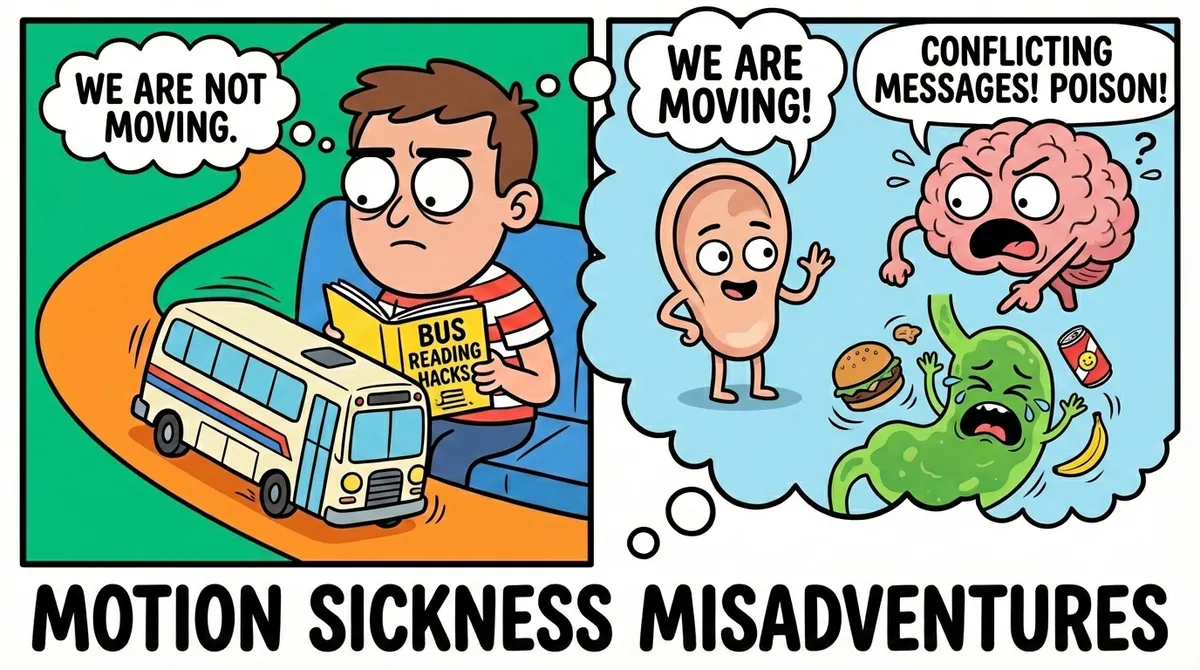
Motion sickness is your inner ear arguing with your eyes while your stomach picks sides.
Your inner ear senses motion. Your eyes, fixed on a book or phone, say you’re stationary. Your brain, receiving conflicting signals, panics and triggers nausea — evolution’s way of saying, “Something you ate might be poisonous; best get rid of it.”
It’s an overreaction, frankly, but your brain doesn’t know the difference between “poisoned” and “reading on a bus.”
The good news: there are ways to help your brain calm down.
What Actually Works
The Pharmaceutical Options
Let’s start with what has the most evidence behind it: antihistamine-based motion sickness medication.
Dramamine (Dimenhydrinate) is the classic. Dramamine being a brand and Dimenhydrinate the active ingredient. It works by blocking signals in the part of your brain that triggers nausea. The trade-off is spending your scenic ferry ride sleeping like you’ve been tranquillised. Because you technically have.
For the original strength formula that actually blocks nausea (drowsiness included):
Dramamine Original Formula
Meclizine (Dramamine Non-Drowsy, Bonine) is the “I still want to function” alternative. Less sedating, but also less effective for some people. Worth trying if regular Dramamine turns you into a sleepy lump.
Dramamine Motion Sickness Less Drowsy
Important: Take these before you need them — at least 30 minutes to an hour before travel. Once you’re actively nauseous, they’re fighting uphill.
The Prescription Option
Scopolamine patches (Transderm Scōp) are the heavy artillery. You stick one behind your ear, and it delivers medication over three days. Popular with cruise passengers and anyone facing rough sea crossings.
These require a prescription in most countries, so plan ahead. They’re the “if nothing else works” tier — more side effects, but more effective for severe cases.
(If you’re reading this from the back of a winding bus, stop. Look at the horizon. We’ll be here when you feel better.)
Natural Remedies: The Supporting Cast
Ginger
Ginger has actual research behind it — not just your grandmother’s wisdom, though she was onto something.
Studies show ginger can reduce nausea, though the mechanism isn’t fully understood. You can get it as tablets, chews, or crystallised ginger. Doses range from “might help” to “your burps taste like Christmas biscuits.”
Tablets are convenient for travel. Something like this works well:
The Ginger People Ginger Rescue Digestive Wellness Lozenges (Hard)
Ginger chews are another alternative:
Advanced Herbals Ginger Chews (from Dramamine maklers)
Acupressure Wristbands
Sea-Bands press on the P6 (Nei-Kuan) acupressure point on your wrist. The evidence is… mixed. Some studies show benefit, others show nothing beyond placebo.
But here’s the thing about placebo: it still reduces nausea. If your brain believes it works, your stomach might follow.
They’re drug-free, cheap, and have no side effects beyond looking like you’re wearing sweatbands from 1985. Worth having as part of your arsenal:
Sea-Band Anti-Nausea Acupressure Wristband
Peppermint
Peppermint oil or aromatherapy inhalers can help settle your stomach. The evidence is weak, but the risk is zero (unless you hate the smell of peppermint).
More about comfort than cure, but comfort matters when you’re trying not to throw up on a crowded bus:
UpNature Peppermint Essential Oil Roll On
The Combination Approach
Here’s what I learned from my North Sea experience: use everything.
I went in with wristbands and tablets. I felt sick most of the time — except, interestingly, when playing cards after dinner. Distraction and keeping my eyes on something that wasn’t moving seemed to help. The moment I’d leave and become aware of the ship’s motion again, the nausea would creep back.
After a week of this (and a glorious few days on the Shetland Islands, where I discovered that Shetland Ponies are very real and solid ground is underrated), the crew chief decided we should head back out to wait for the storm to die down.
I was aghast. Leave perfectly good, non-moving ground? Madness.
But something had shifted. Looking out the porthole at massive waves rolling past, I felt… fine. Better than fine, actually. Strangely happy. My body had finally adapted.
The lesson: sometimes you just need to give it time. But having remedies makes that time bearable.
Quick Prevention Tips
- Look at the horizon — Gives your eyes and inner ear the same information
- Sit in the right spot — Front of the bus, middle of the boat, over the wing on planes
- Get fresh air — Open a window if possible
- Avoid reading or screens — Your eyes need to see motion
- Eat something light — Empty stomachs are worse; dry crackers are not a cure, but something light to throw up if things go south
- Stay hydrated — Dehydration makes everything worse
- Take meds early — They work best preventively
- Pack remedies in your carry-on — The turbulence won’t wait for baggage claim
What to Pack: A Motion Sickness Kit
Consider putting together a small kit with your essentials. Something like this travel medicine kit covers the basics:
Compact TSA-Approved Medication Pack for Travel
and you can add your own touches with extras like:
- Motion sickness medication (your preferred type, the one above uses meclizine, an antihistamine medication used to treat and prevent nausea, vomiting, and dizziness from motion sickness and vertigo like Dramamime Less Drowsy)
- Ginger tablets or chews
- Acupressure wristbands
- Small water bottle
- Dry crackers or plain snacks
- Plastic bags (just in case)
Some links in this article are affiliate links. If you purchase through them, I may earn a small commission at no extra cost to you. You should also consult a doctor when taking medication.
The Bottom Line
Motion sickness is genuinely miserable, but it’s manageable. Start with what has the most evidence (medication, ginger), add what might help (wristbands, peppermint), and use behavioural strategies (horizon-watching, seat selection) to give yourself the best chance.
And if none of this works? At least you’ll have tried everything, which is better than suffering through Iceland’s Ring Road with nothing but regret and a rental car’s floor mats.